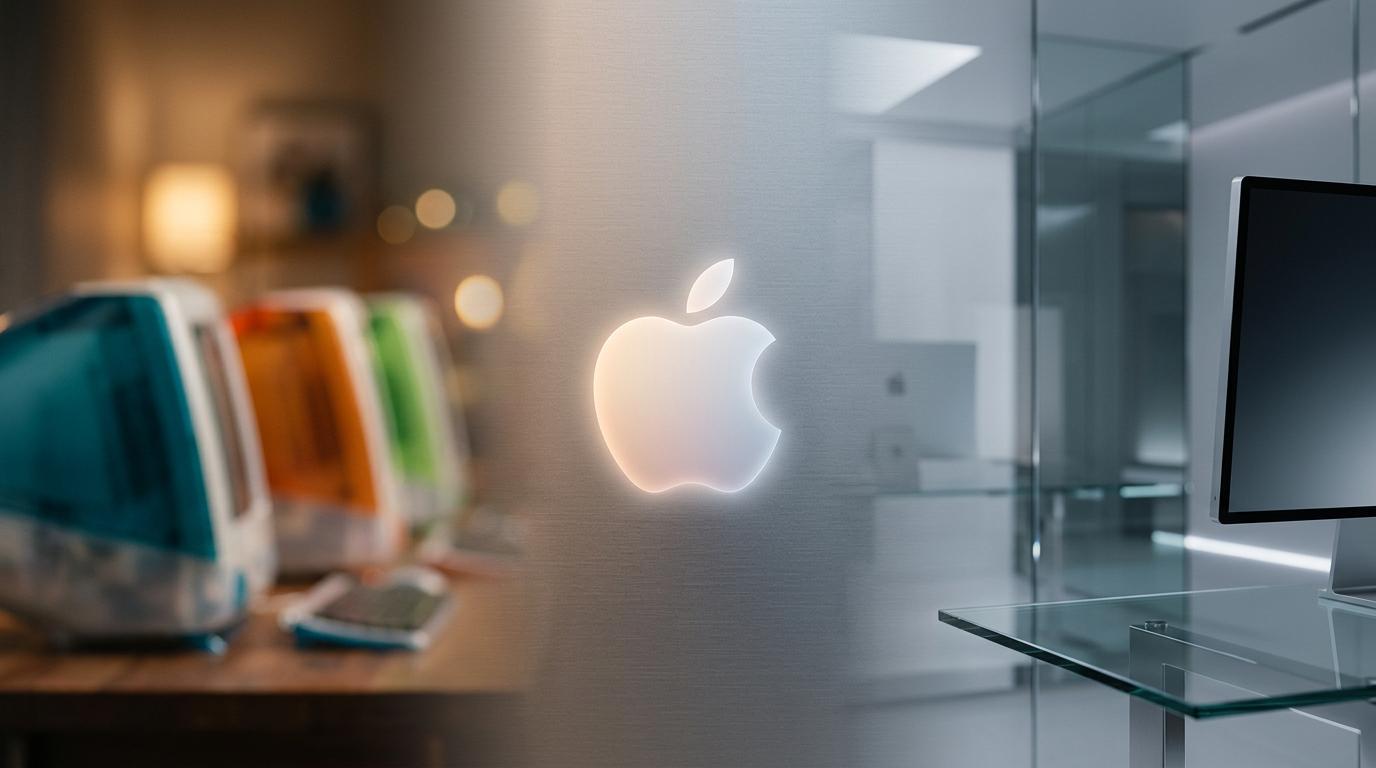
When Apple was 90 days from bankruptcy, Jobs didn’t diversify. He deleted. The principle he used in 1997 is the same one Apple, and most leaders, are still struggling to apply today.
In the summer of 1997, Apple had roughly 90 days of cash left.
The company was losing over $1 billion annually. It had dozens of active products — multiple Mac lines, printers, servers, accessories, peripherals — and it was excellent at almost none of them. It had spread itself across every category it could conceive of, staffed every initiative, and built a product catalog that looked ambitious and was quietly destroying the company.
Steve Jobs had just returned as interim CEO after a 12-year absence. He toured the product lines, studied the financials, and arrived at a diagnosis that most leaders in his position never find the courage to say out loud:
“Apple is executing very well on the wrong things.”
That single sentence is the most important thing any leader in a struggling organization can say. And most never say it.
The Problem Wasn’t Effort It Was Direction
The instinct in a struggling company is always the same: work harder, hire more, find new revenue streams, diversify to reduce risk.
Jobs looked at Apple and saw something different. He saw a company full of talented people working extremely hard in the wrong direction. The problem wasn’t execution. The problem was the strategy that execution was pointed at.
This distinction matters enormously in business and in life. If you’re running hard in the wrong direction, working harder is not the solution. It accelerates the problem.
The question Jobs asked wasn’t “how do we improve performance across our product lines?” It was: “which of these products should exist at all?”
That is a fundamentally different question. And it leads to a fundamentally different answer.
The Decision: Cut 70% of Everything
Jobs reduced Apple to four products.
A clean two-by-two grid: consumer and professional, desktop and portable. iMac. iBook. Power Mac. PowerBook.
Everything else was cut. Not restructured. Not paused pending review. Cut.
Seventy percent of Apple’s products were eliminated immediately.
This created enemies. Every product that died had a team behind it: engineers who had spent years on it, managers whose credibility was tied to it, champions who had defended it in budget meetings. Every cut was a small act of political damage at the exact moment Jobs needed buy-in.
And he made the cuts anyway.
Then he did something even more important: he controlled the narrative around them.
The same week he announced the product cuts, he announced a $150 million investment from Microsoft; Apple’s most hated rival. He stood on stage at Macworld 1997 while the crowd booed and said: “If we want to move forward and see Apple healthy, we have to let go of a few things.”
Not: we failed. Not: we’re desperate. Not: this is a concession.
We have to let go of a few things.
That is the language of someone who has already decided where the company is going and is now bringing others along.
What Happened Next
Within one year, Apple went from $1 billion in annual losses to $309 million in profit.
The iMac sold 800,000 units in its first five months.
Apple’s market cap at the time was roughly $3 billion. That same company is now worth over $3 trillion.
But the numbers, impressive as they are, miss the deeper result.
Every product that defined Apple’s next two decades — the iPod, the iPhone, the iPad, the Apple Watch, AirPods — flowed directly from the clarity Jobs created in 1997. Not because the four-product grid invented those devices. Because the discipline of focus changed what the company was organizationally capable of doing.
When a company has four products instead of forty, every engineer knows what matters. Every design decision has a clear hierarchy. Every resource allocation question has a clear answer. The organizational drag disappears. The best people stop spending their time maintaining mediocre products and start building great ones.
Focus is not a soft concept. It is a mechanical force multiplier.
The Three Principles Inside the 1997 Decision
1. Subtraction Is a Strategy Not a Failure
Every instinct in business says add: more products, more markets, more bets, more optionality.
Jobs did the opposite. He subtracted aggressively and concentrated everything that remained.
This is counterintuitive because addition feels like progress. Every new initiative looks like a new opportunity. Every new product feels like a hedge against the ones that might fail.
But addition without subtraction is how organizations develop organizational debt; the accumulated weight of every past decision that still has a team, a budget, and a roadmap attached to it. Over time, that debt becomes the single biggest drag on a company’s ability to move.
The question is not “what can we add?” It is “what are we willing to stop being?”
2. Revenue From the Wrong Products Is Worse Than No Revenue
This is the principle most operators reject immediately. It sounds irrational.
But consider what wrong-product revenue actually does. It funds the team maintaining the product. It justifies the roadmap. It gives the product a defender in every budget meeting. It makes the eventual cut harder with every quarter that passes, because more people’s jobs and identities become attached to the product’s survival.
If a product generates $10 million a year and consumes $30 million worth of your best people’s attention, the real cost is not $30 million. It is the opportunity cost of everything those people did not build.
Jobs did not ask whether a product made money. He asked whether it belonged in Apple’s future. If the answer was no, the revenue was irrelevant.
3. The Narrative Around a Hard Decision Determines Whether People Follow
Jobs didn’t call the product cuts a failure. He called them moving forward.
He didn’t describe the Microsoft deal as surrender. He described it as part of making Apple healthy.
This is not spin. It is the genuine work of leadership. When you ask people to let go of something they built, they need more than an explanation of what is being cut. They need a vision of what is being built.
If you subtract without giving people something to move toward, you are not simplifying. You are just demoralizing.
How to Apply This Right Now
This is not history. This is a live decision framework.
List every initiative your business is currently running. Every product, market, project, or team with budget and headcount attached to it.
Now ask one question: if only four of these could survive, which four actually drive 80% of the future value of the business?
Not current revenue. Future value.
That is your real strategy. Everything else is a distraction, a sunk-cost hedge, or an emotional attachment dressed up as a business decision.
Kill the rest. Or if that feels too aggressive starve the rest of resources until the truth becomes unavoidable.
The goal is not to do fewer things. The goal is for the things you do to be undeniable.
The 2026 Parallel: Apple Faces the Same Test Again
Here is what makes this case study unusual. The story is still happening.
Apple in 2026 is the most valuable company in history. It has over $130 billion in cash, 23% iPhone revenue growth in Q1 fiscal 2026, and a hardware business that remains dominant.
And it is strategically overextended.
It is simultaneously trying to be an AI company, an AI infrastructure company, a spatial computing company, a privacy-first platform, and the world’s best hardware manufacturer.
That is the modern version of the 1997 product catalog.
The AI problem: Apple’s promised Siri overhaul — the core of Apple Intelligence — was delayed out of 2025 due to repeated technical failures. Apple’s internal models were found to be well behind competitors. The company tested AI from OpenAI, Anthropic, and Google before announcing a multiyear deal with Google in January 2026, paying an estimated $1 billion per year for access to a custom 1.2 trillion-parameter Gemini model. Apple’s current cloud AI uses 150 billion parameters. That is an 8x gap.
The Vision Pro problem: Apple’s $3,499 spatial computing headset sold only 45,000 units in Q4 2025, down from 390,000 in its 2024 launch year. Manufacturing partner Luxshare halted production. Apple cut Vision Pro advertising by more than 95% in key markets. A lower-cost version was shelved.
Apple is now pursuing three simultaneous response tracks: betting on silicon as the AI moat (M5 chips, AI server infrastructure), pivoting to a mass-market Apple Glass wearable expected in late 2026 or 2027, and framing privacy architecture as its long-term differentiator.
Three tracks. No declared answer.
That is the precise condition Jobs diagnosed in 1997: executing well on too many things.
The Difference Between 1997 and 2026
| Dimension | Jobs 1997 | Cook 2025–2026 |
|---|---|---|
| Core problem | Too many products, no focus | Too many bets, no AI model advantage |
| Financial situation | $1B+ losses, 90 days cash | $130B+ cash, highly profitable |
| External partnership | Microsoft ($150M) to signal stability | Google ($1B/year) to power Siri |
| New category bet | iMac as consumer re-entry | Apple Glass as mass-market AI wearable |
| Decision style | Surgical, immediate, public | Gradual, staged, managed |
| First principle applied | Subtraction as strategy | Optionality as strategy |
Cook’s approach is not irrational for a company of this scale. Gradual is how you avoid creating chaos inside a $3 trillion business.
But gradual also means the question stays open.
And open strategic questions, in companies and in lives, are a continuous drain on energy, clarity, and momentum.
Build, Buy, or Borrow — And Why You Can Only Really Choose One
When any organization or person faces disruption from a faster-moving external force, there are exactly three options:
Build: Invest to match the best in class yourself. Apple tried this with internal AI development. The result was models 8x less capable than Google’s.
Buy: Acquire the capability. Apple has $130 billion. An AI acquisition at scale is fully plausible.
Borrow: Partner with the best available provider while rebuilding on your own timeline. This is what the Google Gemini deal represents.
None of these is the wrong answer in isolation.
The mistake is doing all three simultaneously without committing to one. When you hedge across all three, you do not gain optionality. You dilute commitment. Your organization reads the ambiguity and fills it with their own interpretation, usually the most conservative one available.
Jobs’s gift in 1997 was the willingness to name the answer.
Not to keep options open. Not to preserve political capital by avoiding a clear declaration. To say: this is what we are, these are the four things, everything else is noise.
The modern question for Apple is the same as it was in 1997: not what are we building, but what are we finally willing to stop building?
This Applies Beyond Business
The same principle lives in a well-lived life.
When you get hit by a real shift, not a bad quarter, a genuine shift, you face the same three options. A job elimination after years in one field. A move, a loss, a relationship ending, a realization that the life you’ve been building isn’t the one you actually want.
Build: become the person who can thrive in the new reality. Retrain. Rebuild habits and identity.
Buy: bring in external capability immediately. Coaching, therapy, community, mentorship.
Borrow: use someone else’s platform while you figure it out. A bridge role. A temporary reset. Time bought by leaning on others.
All three are valid.
Most people quietly try all three at once: half-commit to rebuilding, dabble in a course or two, spend money on help they never fully use, stay in a role or relationship that stopped working years ago, and call it keeping options open.
That is not strategy. That is postponed decision-making.
The real question is which path you are actually going to bet on and what you are willing to stop pretending is still possible.
Because strategy in a life works exactly the way it works in a company.
It is not the list of possibilities.
It is the list of things you are finally willing to cut.
The Bottom Line
Steve Jobs saved Apple in 1997 not by finding new revenue, not by diversifying, and not by running harder in the same direction.
He saved it by subtracting.
By having the clarity to name what Apple was — four products, two axes, one identity — and the courage to kill everything that didn’t fit.
The question that principle leaves for every leader, founder, and person navigating a real decision:
What in your life or business right now would a rational outsider cut immediately?
And why haven’t you?
The answer to that second question is where the real constraint lives.
Not in the market. Not in the competition.
In the decision.
Make the cut.
If you’re working through a pivotal decision of your own, The Edge Forums is where founders, executives, and operators sharpen the decisions most at risk of defining them. Apply or ask a question here.
Unstoppable is a decision intelligence podcast for leaders who refuse to settle. Hosted by Jana. New episodes weekly.