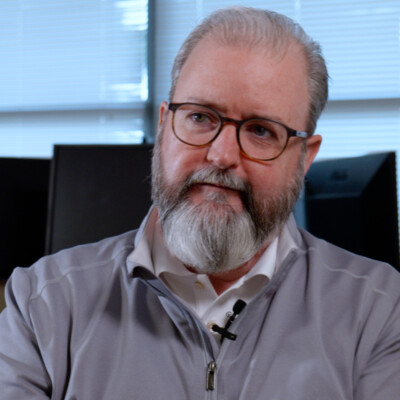

Scott Trumpolt on the Decision That Built a 14-Year Consulting Practice
Scott Trumpholt was sitting in a conference room in Germany. Smart people. Real budget. A project that could move the company forward.
They spent the meeting debating what to call it.
That was the moment.
Not a layoff. Not a fight with a boss. Not a number on a spreadsheet. A room full of capable executives, burning hours on the title of a slide.
For Scott, that meeting was the data point that confirmed what he already suspected. The work he loved had been crowded out by everything else. Two decades of climbing the corporate ladder had taken him further from the actual craft — compensation design — and deeper into administration and bureaucracy. He was being paid more to do less of what he was best at.
Eighteen months later, he was running his own consulting practice. That was 14 years ago. He has not gone back.
This week on Unstoppable, Scott and I unpacked the decision behind the decision. Not “should you leave corporate?” The more useful question is: what are you actually solving for?
The Inflection Point Is Rarely the Trigger
When people tell the story of leaving corporate, they tend to pick a clean moment. The bad performance review. The acquisition. The CEO who lost the plot.
Scott’s story is more honest. The title-of-the-project meeting was not the cause. It was the confirmation.
The actual decision had been forming for years.
His ratio had flipped. Early in his career, eighty percent of his time was on the design work he loved. By the time he was running a center of excellence in Germany, it was twenty percent. The rest was bureaucracy.
He was living apart from his wife. He had taken the international assignment with the understanding that he would come home every couple of months. The math stopped working.
He was no longer learning. He had accumulated the expertise. The next rung of the ladder offered more responsibility, not more growth in the area he cared about.
When he finally watched the conversation about the project title play out, he did not have an epiphany. He had a recognition.
That is how most inflection points work. The decision is already made. You are waiting for permission to admit it.
The Trade Scott Actually Made
There is a lazy version of this story: he chased his passion. Skip it.
What Scott did was reframe the risk equation.
The corporate version of security looks like this: one employer, one paycheck, one HR system handling your healthcare, retirement, and continuity. Predictable until the automated message tells you it is not.
The independent version of security, which Scott figured out by year five, looks different. Multiple clients. Multiple revenue streams. A market you sell into directly. Less protection from any one thing. More control over the whole thing.
He did not trade safety for risk. He traded the appearance of safety for actual leverage.
The piece most people miss is that this trade only works if you have built the underlying expertise to charge for. Scott had twenty years in compensation, a master’s degree, deep relationships, and within his first year as a consultant he sat for the certification exams in his field. Not because he had to. Because he wanted clients to know he could.
Passion without expertise produces a hobby. Expertise without passion produces burnout. Scott had both. That is the only reason the math worked.
The One Question Worth Sitting With
Scott walks through twelve diagnostic questions in his book, The Defragmented Consultant. They cover the practical pieces: runway, healthcare, retirement, marketing, the merging of personal and business identity that comes when you become a force of one.
The one he kept circling back to was the hardest.
Do you want to be a consultant because this is what you do for a living? Or because you actually love it?
That distinction sounds soft. It is not.
It is the difference between someone who keeps the lights on during a six-month dry spell and someone who quietly goes back to corporate at month four. It is the difference between the consultant who writes the blog, records the podcast, and gets on the airplane during a slow stretch, and the one who feels sorry for themselves and waits for the phone to ring.
Scott put it this way: “If I find myself sitting there feeling sorry for myself, I only dwell on that for a little while. Then I get productive.”
That is the operating system of an independent consultant. Not the certifications. Not the marketing funnel. The internal default that says when nothing is happening, I am the variable.
If your honest answer to “do you love this?” is “I am good at it and the money is fine,” do not leave corporate. The job is protecting you from yourself.
Why Timing Matters More Than Most People Admit
Scott was clear that the same decision five years earlier would have failed.
Not because he lacked expertise. He was already a strong compensation analyst.
Because he had not yet built the network, the breadth of fit, the muscle for ambiguity, or the financial cushion that turned the leap from a gamble into a calculated bet.
People romanticize the early-career leap because it makes a better story. The founders and operators who build durable independent practices tend to leave in their forties, with two decades of pattern recognition and a Rolodex that returns calls.
If you are in your twenties and you are not learning fast inside your current role, leave. Optimize for learning rate.
If you are in your forties and you are no longer learning, you have a different problem. You have outgrown the structure. That is when the question becomes useful.
The Self-Check Before You Make the Call
If you are sitting somewhere in this story right now, here is the diagnostic worth running before you do anything else.
What percentage of your time is spent on the work you were hired for, the work you are actually best at?
If it has dropped below thirty percent and the trajectory is going the wrong direction, you are not bored. You are misallocated.
What does your network look like outside your current employer?
If the answer is “I do not have one because I have been heads-down for a decade,” the leap is premature. Build the network first. The leap gets easier when there is somewhere to land.
What is your honest answer to Scott’s question?
Not the answer you would give in a Sunday morning conversation with your partner. The answer you would give if there were a check on the table and a two-year lock-in contract next to it. Do you love this?
If yes, the rest of the math is solvable.
If no, do not leave corporate to do the same work for yourself. You will burn the cushion and end up back where you started — two years older and more cynical.
What Scott Got Right That Most People Miss
The throughline of Scott’s fourteen years is not luck. It is rhythm.
When clients are flowing, he delivers. When clients are not flowing, he writes the book, takes the podcast interview, gets the certification, updates the website, and stays in motion. He never lets the dry spell become the identity.
That cadence is what compounds. Not the marketing tactics. Not the lead generation funnel. The refusal to wait.
It is also why his business card reads founded on passion, sustained by principle. The passion gets you out. The principles keep you out.
Listen to the Full Episode
Scott Trumpholt is the founder of Trumpholt Compensation Design Solutions and the author of The Defragmented Consultant. He spent nearly two decades in corporate leadership across the United States and Germany before going independent. In our full conversation on Unstoppable, we get into the twelve questions worth answering before you leave, the role his wife played in the decision, what he wishes he had mapped on paper before the leap, and how he rebuilt his pipeline after word-of-mouth dried up.
If you are sitting at this inflection point — capable, high-performing, increasingly misallocated — the question is not whether you can do it. The question is whether you should.
Stay unstoppable.
About Our Guest
Scott Trumpolt is the Managing Director and Principal Consultant of Trumpolt Compensation Design Solutions (TCDS), which he founded in 2012 after leaving an 18-year corporate HR and compensation career spanning the United States and Germany. He helps CEOs, HR leaders, and business owners build market-based pay structures, clear career frameworks, and sales incentive plans that drive performance without overspending — work that has reached organizations from 50 to 10,000 employees across North America, Europe, Asia Pacific, and Latin America/Caribbean.
He holds a Master’s in Human Resources Management and the Global Remuneration Professional (GRP) certification, and is the author of The Defragmented Consultant, a practical guide for professionals building sustainable independent consulting practices.
Connect with Scott: Website · LinkedIn · The Defragmented Consultant on Amazon