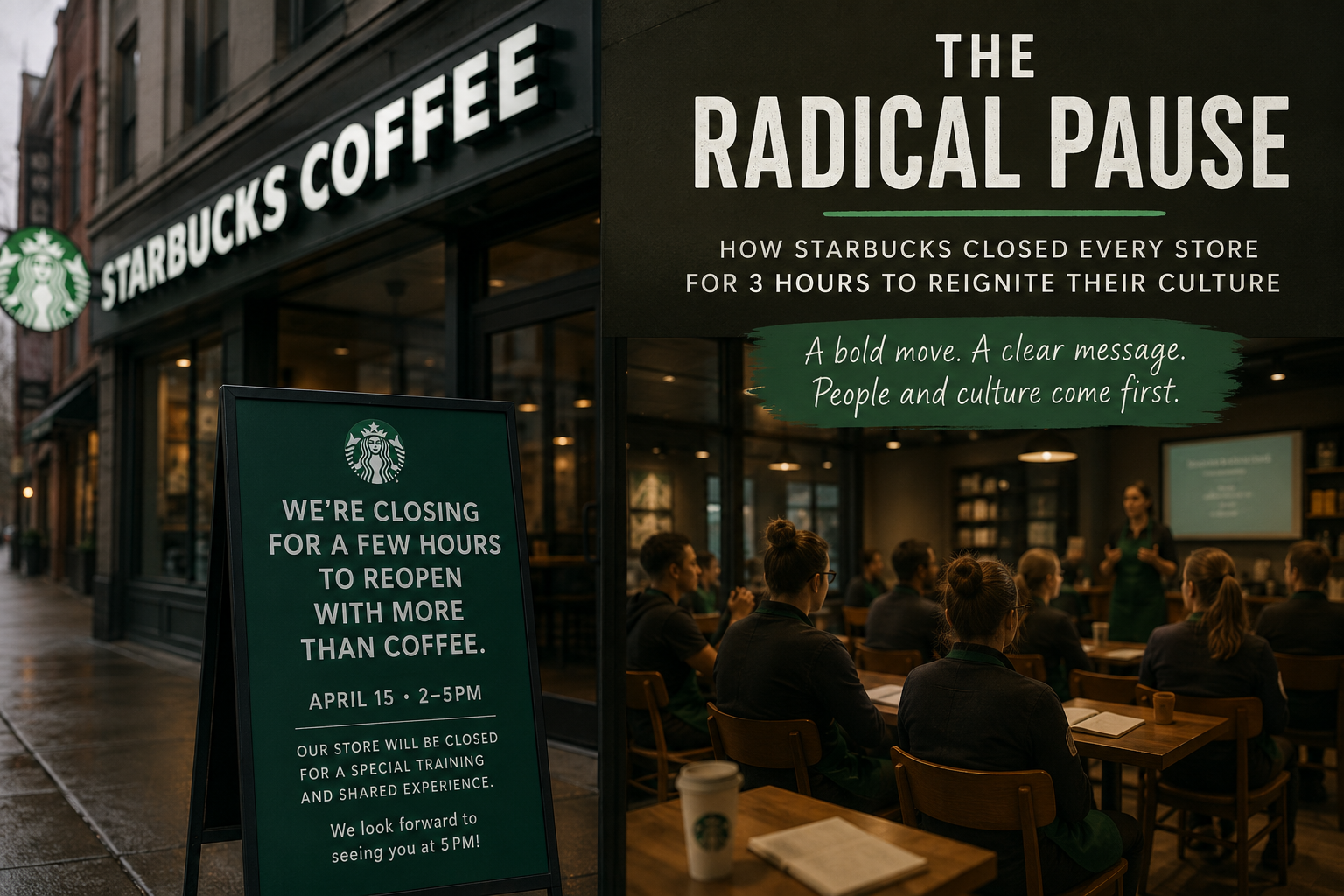
February 26, 2008. 5:30 p.m. Across the country, people are finishing their workday and heading to the nearest Starbucks. They find the doors locked. Not at one store. Not in one region. All 7,100 of them, at once, on purpose.
The CEO walked away from six million dollars in revenue in a single evening, while the stock sat at seven dollars, down from thirty-nine. The financial crisis was tearing through every balance sheet in the country, and Starbucks, a four-dollar coffee in a downturn, had become shorthand for everything reckless about the old economy. McDonald’s and Dunkin’ were circling with real competition for the first time. Dunkin’ put up signs that said “we’re open, come visit us.” Analysts called the closure reckless. The board was nervous.
Howard Schultz didn’t care, because he wasn’t fixing the espresso. He was fixing the belief system underneath it.
Here’s the question worth sitting with before you read another word: when the thing you built starts drifting from what made it worth building, do you have the clarity to diagnose the real problem, and the conviction to do something that looks irrational on a spreadsheet but is surgically correct for the culture? Most leaders lose between a rational response and the correct one.
The Backstory That Explains the Decision
Starbucks wasn’t built on a business model. It was built on a promise.
Schultz grew up with nothing. His father was a blue-collar worker with no safety net and no margin for error. When Schultz was seven, his father broke his hip and ankle on the job. No health insurance. No severance. The family waited it out. That moment never left him.
Decades later, when Schultz built Starbucks, he extended health insurance to part-time workers, gave employees stock, and called them partners. Not because a consultant recommended it as a retention strategy. Because he’d made a promise to himself at age seven that he would build the company his father never got to work for.
That promise was the foundation. And by 2008, the machine Schultz had built was quietly trading it away, one sensible, defensible decision at a time.
Five Fires, One Cause
When Schultz returned as CEO in January 2008, the stock jumped eight percent that day. That single data point tells you how bad the market thought things had gotten.
He walked into multiple fires burning at once. Starbucks had been opening six or seven new stores a day at the peak of expansion, chasing a target of 40,000 global locations, and standards had slipped in the rush. The global financial crisis had made a four-dollar coffee an easy symbol of unnecessary spending. McDonald’s had launched McCafe and Dunkin’ was repositioning aggressively, giving Starbucks real, credible competition for the first time in its history. Internally, standards had eroded and baristas had been de-skilled by automation. And the brand itself had become a symbol of excess rather than the community gathering place Schultz had originally built.
Here’s the move that separates what Schultz did from what most operators do in a moment like this: he looked at the five fires and said, “four of these are real, but external. One of them, I caused. And the one I caused is why the other four are lethal.”
Growth had become a carcinogen. Not a competitor, not a market cycle. A carcinogen: something that spreads silently through what looks like healthy tissue, and by the time the symptoms show up, the damage is already systemic.
What the Disease Actually Looked Like
The espresso machines had been automated. Drinks came out faster, throughput improved, labor costs dropped. And the craft disappeared. There used to be a moment when you’d watch a barista pull a shot, tamp the grounds, time the extraction, steam the milk with technique. It was theater, and people paid a premium partly for the theater.
Coffee shifted to pre-ground, vacuum-sealed bags. More efficient. More consistent. It also eliminated the smell of fresh-ground beans, one of the most powerful sensory signals in the entire Starbucks experience. Hot breakfast sandwiches got added because they drove margin, and they filled the stores with the smell of melted cheese, which overpowered the coffee entirely.
Every one of those decisions had a rational business case behind it. That’s what makes this pattern so dangerous: none of the individual choices looked wrong in isolation. The accumulation was lethal.
You’ve probably watched a version of this happen somewhere you’ve worked. A professional services firm builds its name on genuinely hard, original strategic work. Retainer clients feel safer than project work, so the firm chases more of them. Retainers get staffed with mid-level teams to protect margin. The firm starts solving the same problems on repeat, because that’s what the retainer model rewards. A decade in, senior partners are managing relationships instead of doing the work that built the reputation in the first place. Revenue is fine. The thing that justified the premium is gone. When a sharper, cheaper competitor shows up, the firm has nothing left to defend at the top of the market.
That’s exactly where Starbucks stood in 2008. Strip out the experience, and the only lever left is price, and Starbucks had made itself substitutable at the precise moment two credible, lower-cost competitors arrived.
Four Options, Three of Them Wrong
Starbucks had four real paths forward, and each one maps to a decision you’ve faced or will face at whatever level you operate.
The standard turnaround. Cut costs hard, close underperforming stores, protect margin, reassure investors. This is the playbook every CFO and restructuring consultant would have handed Schultz, and it was completely wrong for this situation. Aggressive cost-cutting would have degraded the experience further, made the company more substitutable, and accelerated the exact trust erosion that caused the revenue problem. It treats the symptom as the disease.
The product and marketing offensive. New drinks, promotions, discounting to recover traffic. You could build a compelling ninety-day plan around this. The problem: traffic wasn’t down because the product failed. It was down because the experience had degraded and the premium no longer felt justified. A discount doesn’t rebuild trust; it confirms that the premium was never real to begin with, and it trains customers to wait for the next deal.
The gradual cultural reset. Retrain baristas over time, roll out new standards store by store, keep the organization stable while signaling change. This feels mature and responsible. It also fails to create the one thing that actually moves an organization: a shared before-and-after moment that every person inside it can point to. Watch a company try to gradually change its culture over three years and you’ll see what I mean. Gradual change doesn’t build belief. It builds a slower version of the same drift, with better language attached to it.
The radical pause. Close all 7,100 stores in one evening. Absorb the six million dollars. Retrain 135,000 baristas simultaneously, across the entire country, in the same three-hour window. This fails every conventional business-case test. It was, strategically, surgery.
The Closure Was the Message
Here’s what most people miss about that evening: the espresso training was almost beside the point.
Baristas said afterward that the most powerful part wasn’t learning to pull a better shot. It was the act of stopping. For the first time, every person in the company, from a new part-timer to a senior director in Seattle, got the same message at the same moment: we are not okay with where we are, and we are going back to what made this worth building. The closure was the message. The training was just the vehicle.
Think about what that translates to at the level where your decisions actually happen. A transformation lead stands up at a governance review and says: we’re pulling the current implementation and going back to requirements. Not because anyone required it, but because the root cause is upstream and continuing forward would compound the error. The cost is real. The delay is uncomfortable. The visibility is high. But the signal it sends, that this person has the clarity to name what’s wrong and the conviction to stop it, is worth more than six months of recovered timeline. That person walks out of the room with more authority than they walked in with.
Schultz paired the closure with a set of moves that reinforced the signal instead of undercutting it. He closed 600 underperforming stores, with 300 more to follow, framed not as cost-cutting but as quality control. He killed the hot breakfast sandwiches, giving up meaningful annual revenue because they violated the sensory identity of the brand. He brought back whole-bean grinding in stores and launched Pike Place Roast specifically to restore the coffee smell that had disappeared. He gathered 10,000 executives and store managers in New Orleans, a city that had been destroyed and rebuilt, and the symbolism was deliberate. He refused to touch partner health benefits or stock participation, even at the bottom of the crisis, because those weren’t perks. They were the founding promise.
The Ownership Move
Then Schultz did the thing I think is the single most instructive move in the entire case. He stood up publicly and named the cause: the automated machines, the pre-ground coffee, the acceleration that stripped the craft out of the business. “That’s on me,” he said. “I was chairman during all of it.”
He didn’t blame the recession. Didn’t blame the previous CEO. Didn’t list competitive headwinds. He named his own decisions.
You’ve sat in that room before, or one like it. A leader is explaining a program that went sideways, and they spend the first forty-five minutes on external headwinds, vendor failures, resourcing gaps, market conditions, without once saying “here is specifically what I decided that made this worse.” You know exactly how that room responds. Not because the external factors aren’t real. Because the room is quietly doing the math on what this person actually controlled, and every minute spent on external attribution is a minute the leader loses credibility.
Schultz did the opposite, and the structural effect was immediate. When the person with the most to lose accepts full responsibility for the cause, the organization stops spending energy on blame and starts spending it on the fix. Every decision after that carries more weight, because the room now trusts that the diagnosis was honest. This isn’t a humility exercise. It’s authority architecture.
The Numbers, and the Part Most People Skip
By the numbers, it worked. Starbucks stock surged 143 percent in 2009. Net income recovered from roughly $315 million at the crisis low to about $564 million the following fiscal year, nearly doubling in twelve months. Same-store sales began recovering within a year of the turnaround launching. Over the following decade, the stock delivered roughly ten times its return from the 2008 lows.
The story doesn’t end there and it’s the part that actually changes the lesson: the company broke again.
By 2022 and 2023, the same forces were back at work. Mobile ordering, introduced to modernize the experience, created chaos at the bar as baristas juggled in-store and digital queues simultaneously. Wait times climbed. Drinks got inconsistent again. The menu had ballooned to hundreds of customization combinations. Seating got pulled out of stores to increase throughput. The third place was disappearing all over again.
In August 2024, the board fired the CEO, brought Schultz back for a second stint, and then installed Brian Niccol, the executive who’d engineered Chipotle’s recovery from a food safety crisis that nearly destroyed that brand. Starbucks stock surged 24.5 percent on the announcement alone. When Schultz heard Niccol’s framing for the turnaround (back to Starbucks), he said he did a cartwheel in his living room. By mid-2026, global comparable sales were up 6.2 percent, ahead of analyst expectations. North American same-store sales were up 7.1 percent, and North American operating income was up nearly 30 percent year over year. The ship is turning again.
Which raises the sharper question underneath all of it: if the same forces broke the company the same way twice, is the playbook actually solving the problem, or is it buying time until the next growth cycle overwhelms the culture again?
That tension is exactly where the real principles live.
Three Principles Worth Building Into Your Operating System
Culture drift doesn’t respond to a program. It responds to a scar.
When a system has been eroding quietly through years of individually reasonable decisions, incremental fixes don’t move it, because the people inside the system can’t tell the difference between a real intervention and another initiative that will be forgotten in two quarters. New value statements don’t move organizations. Off-sites don’t move organizations. A memo from the CEO doesn’t move organizations. A visible, costly, irreversible action that creates a shared before-and-after for everyone at once, that moves organizations. The six million dollars wasn’t a cost. It was proof. Proof that this wasn’t another slide deck.
If a corrective action feels comfortable, it won’t be believed. If it makes someone at the leadership level genuinely nervous about whether it was worth it, you’re probably in the right zone. Ask yourself when you last did something that cost you something real in order to signal what actually matters, not a policy, not a statement, but an action with a visible price tag attached. If you can’t think of one, that’s probably telling you something about why the drift you’re worried about is still happening.
Total ownership of the self-inflicted wound is the fastest path to credibility in the room.
This is the principle I want you to internalize, because it runs directly against instinct. When a leader explains a failure without naming their own decisions as part of the cause, the room stops believing the diagnosis. People have heard external attribution before. They know what you controlled. Every minute you spend on headwinds and market conditions without a single “here’s what I decided that made this worse” is a minute the room spends quietly deciding whether you actually understand what happened, or whether you’re managing the narrative.
Credibility in that room isn’t determined by your title. It’s determined by whether people believe you’re giving them an accurate read of reality, even when it costs you something to say it. The leader who explains a mixed result by pointing outward is explaining. The leader who says “here are the three specific decisions I made that created this, and here’s what I’m changing” is leading. If you don’t own the cause, no one trusts the cure.
Growth without explicitly protecting the incompressible layer is just self-erosion.
Every business, and every senior leader, has an incompressible layer: the thing that loses its value the moment you optimize it for efficiency or scale. For Starbucks, it was the sensory experience, the reason someone paid four dollars instead of a dollar fifty. When that layer got compressed (the automated shot, the pre-ground beans, the smell of melted cheese), the company didn’t just get slightly worse. It lost its moat, because the experience was the moat.
The trap is that none of the individual decisions looked wrong in isolation. Every one had a rational case. Automating the shot saves forty-five seconds per drink, and across millions of transactions, that’s real money. Pre-ground beans are cheaper and more consistent. Breakfast sandwiches improve margin. Each decision, rational. The accumulation, lethal. Starbucks told this story twice, in 2008 and again in 2024, because the compression forces (scale pressure, throughput metrics, quarterly reporting that rewards efficiency) never stop pushing. Nobody decides to erode the soul of a business. It happens one sensible decision at a time, made by people doing exactly what they were asked to do.
Identify what’s incompressible in what you’re building. Then build explicit protection around it, not in your mission statement, but in your operating metrics, in what gets reviewed at the leadership level, in what triggers a real conversation when it starts to slip. Without that protection, scale will erode it through a hundred perfectly reasonable decisions.
What This Means for the Decision in Front of You
If you’re a founder or CEO scaling something right now, start with one question, and make it specific: where have you been optimizing for efficiency at the cost of the thing clients actually pay a premium for? Not rhetorically. Name it. Where has throughput started replacing quality? Where has “good enough at scale” started beating “exceptional and hard to replicate”?
Then ask what your version of the store closure looks like: the visible, costly, unambiguous action that tells everyone inside the company, and maybe in your market, that the reset is real. Not a strategy document. An action with a price tag. Killing a profitable line that’s diluting the brand. Cutting a product that exists because you can build it, not because it belongs in your company’s future. Publicly removing a metric that’s driving the wrong behavior, even when it makes your near-term numbers look worse. If the action doesn’t make someone at the board level genuinely uncomfortable, it probably won’t create the belief you need internally.
If you’re an executive or senior leader, the move worth studying most closely isn’t the store closure. It’s the ownership move. Before your next difficult governance review, write out the specific decisions you made that contributed to the current situation, not the external factors, your decisions. Practice saying them out loud without softening them at the end. That’s the version of the story that builds credibility. Not the version that protects you in the room.
And regardless of your role, ask honestly what the incompressible layer is in what you’re building, or in what you’re building your career around. It might be the intellectual depth of your work, the standard you hold yourself to when nobody’s checking, the quality of your decisions when the timeline is tight, or the relationship that exists outside the transaction. Then ask what reasonable, defensible decisions you’ve been making that are quietly eroding it.
The Real Question
Schultz didn’t wake up one day and decide to ruin Starbucks. He made a long series of sensible choices in service of growth, and one day he looked up and the thing his promise had built was almost unrecognizable. That trajectory is available to anyone operating under sustained pressure, not through bad decisions, but through a long sequence of good ones that quietly accumulate into the wrong destination.
The question isn’t whether that kind of drift is possible in what you’re building. It already is. The real question is whether you have a mechanism to catch it before it requires a crisis to reverse, because the leaders who catch it early, who run the diagnostic before the forcing function arrives, pay the cost of the pause. The ones who don’t pay the cost of the crisis. Schultz had to be forced twice. The stock at seven dollars. The financial crisis. The competitor circling. Then again in 2024.
What’s drifting in what you’re building right now, not because anyone decided to let it drift, but because no one has stopped long enough to see it? And what would it cost you to address it before it costs you everything?
Stay unstoppable.
If you’re working through a pivotal decision of your own, The Edge Forums is where founders, executives, and operators sharpen the decisions most at risk of defining them. Apply or ask a question here.
Unstoppable is a decision intelligence podcast for leaders who refuse to settle. Hosted by Jana. New episodes weekly.
Key Takeaways
Culture drift happens through a long series of individually rational decisions, not one bad call, which is exactly what makes it hard to see and even harder to reverse with a program instead of a scar.
Schultz’s diagnostic move (separating four external fires from the one internal cause he named as “growth is a carcinogen”) is the template for distinguishing what happened to you from what you did to yourself.
Of the four turnaround options available (standard cost-cutting, a marketing offensive, a gradual reset, or a radical pause), only the disproportionate, visible, costly action created a shared before-and-after moment strong enough to be believed.
Publicly naming your own decisions as the cause of a failure, without hedging or external attribution, is the fastest way to earn credibility in a high-stakes room; it is authority architecture, not a humility exercise.
Every business has an incompressible layer that loses its value the moment it’s optimized for scale, and protecting it has to live in operating metrics and leadership reviews, not a mission statement.
Starbucks broke the same way twice, in 2008 and 2024, which is a warning that the discipline of protecting culture and identity has to be ongoing, not a one-time crisis response.
FAQ
What does “culture drift” mean in a business context?
Culture drift is the gradual erosion of an organization’s identity, standards, or founding promise through a series of individually reasonable decisions made in the name of growth or efficiency. It’s dangerous specifically because no single decision looks wrong in isolation; the damage only becomes visible once it has compounded into a systemic problem, as happened at Starbucks between 2008 and 2024.
Why did Howard Schultz close all 7,100 Starbucks stores in 2008?
Schultz closed every U.S. Starbucks location simultaneously for three hours on February 26, 2008, to retrain baristas on espresso fundamentals that had been lost to automation and throughput optimization. The training itself was secondary; the real purpose was to create a single, shared, undeniable moment that told everyone inside the company the organization was stopping and returning to the standards that had made it worth building. The closure cost roughly $6 million in lost revenue.
What is the “incompressible layer” of a business?
The incompressible layer is the element of a business that loses its value the moment it’s optimized purely for efficiency or scale. For Starbucks, it was the sensory, in-store experience: the smell of fresh-ground coffee and the visible craft of a hand-pulled espresso shot, which justified a premium price. When that layer gets compressed through automation or cost-cutting, a business doesn’t just get slightly worse; it can lose the actual moat that differentiated it from competitors.
Why is publicly owning a mistake more effective than explaining external factors?
When a leader spends most of an explanation on external headwinds without naming their own decisions, the room typically stops trusting the diagnosis, because people already have a sense of what the leader actually controlled. Publicly and specifically owning the decisions that caused a problem, as Schultz did when he took responsibility for automating Starbucks’ equipment and adding products that diluted the brand, shifts the room’s energy from assigning blame to solving the problem, which builds more credibility than any external explanation could.
Did Starbucks’ 2008 turnaround permanently fix the company’s culture problems?
No. By 2022 and 2023, similar forces (this time mobile ordering complexity, menu bloat, and reduced in-store seating) had eroded the same “third place” experience Schultz fought to restore in 2008. The board fired the CEO in August 2024 and brought in Brian Niccol, architect of Chipotle’s turnaround, to run a similar “back to Starbucks” recovery. The recurrence suggests that protecting a company’s core identity against growth pressure has to be a continuous discipline, not a one-time crisis response.
What is the difference between a “program” and a “scar” when resetting company culture?
A program (a new value statement, an off-site, a memo from leadership) rarely shifts an organization’s culture because employees can’t distinguish a genuine reset from another initiative that will fade in a quarter or two. A “scar,” by contrast, is a visible, costly, and often irreversible action that creates a shared before-and-after moment for everyone in the organization at the same time. Starbucks’ 2008 store closure is the clearest example: the cost and disruption were what made the reset believable.