
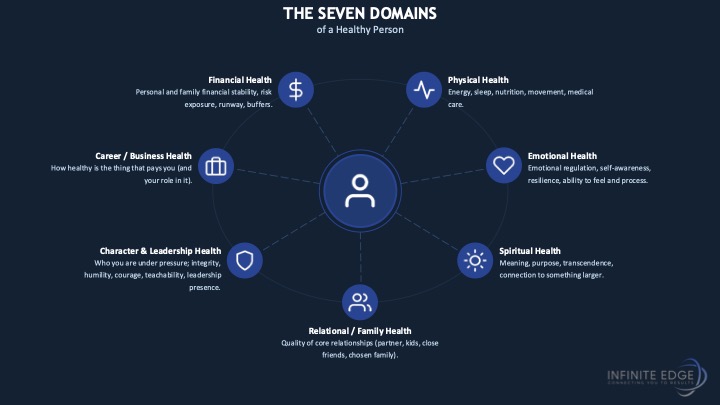
High performers rarely fail because they aren’t driven; they fail because their drive collapses their life into a single domain and quietly lets the others erode. At Infinite Edge, we take the view that sustainable high performance means being very strong in one or two domains, while deliberately keeping the others above a defined minimum standard—not perfect, but intact.
What happens when high performers become single-domain workaholics?
There is a pattern you see often in founders and senior leaders: they pour everything into their career or business health and assume the rest will take care of itself later.
Research on workaholism and high achievers makes the trade-off clear: workaholism (working excessively and compulsively at the expense of other life roles) is strongly associated with ill-health and only weak or inconsistent links to superior job performance.
Studies find that workaholics are more likely to report psychological distress, physical complaints, and reduced work quality, even as their hours rise. In short, outworking everyone does not reliably translate into better results; it often translates into poorer health and strained relationships.
From a systems perspective, this is a single-domain strategy: max out one area (Career / Business Health) while allowing Physical Health, Emotional Health, and Relationship Health to degrade below the threshold where they can support continued performance.
What does balanced high performance actually look like?
There is a different pattern: high performers who stay in the game longer because they deliberately engage across multiple life domains, even if they don’t optimize all of them equally.
Work–life balance research suggests that life satisfaction is strongly tied to engagement across work and non-work roles and to limiting conflict between those roles, not to equal time allocation. Effective balance comes from setting satisfaction limits—clear boundaries on how much neglect you’re willing to tolerate in each domain—rather than chasing perfection everywhere.
Self-regulation research adds that maintaining standards across domains (health, family, work, leisure, finances) relies on intentional goals and minimum standards, not just willpower in the moment.
These leaders are still exceptional at something (often in the Career / Business domain) but they refuse to put all their eggs in that basket. They protect basic physical health, maintain key relationships, and keep some sense of meaning and financial stability intact.
They don’t live a “perfectly balanced” life. They live a life where no domain is allowed to fall below the minimum standard required to support the others.
What are the Seven Domains of a Healthy Person?
At Infinite Edge, we capture this idea in the Seven Domains of a Healthy Person:
Physical Health – Energy, sleep, nutrition, movement, medical care.
Emotional Health – Emotional regulation, self-awareness, resilience, ability to feel and process.
Spiritual Health – Meaning, purpose, transcendence, connection to something larger.
Relational / Family Health – Quality of core relationships (partner, kids, close friends, chosen family).
Character & Leadership Health – Who you are under pressure; integrity, humility, courage, teachability, leadership presence.
Career / Business Health – How healthy is the thing that pays you (and your role in it).
Financial Health – Personal and family financial stability, risk exposure, runway, buffers.
For most founders and executives, Career / Business Health will always carry disproportionate weight. That’s fine. The point is not to flatten all seven domains into equal importance. The point is to treat them as an interconnected system.
If Physical, Emotional, Relational, or Character Health drop below a certain floor, the system destabilizes, even if the business numbers look strong for a while.
Why define minimum standards instead of chasing perfection?
A well-rounded life does not mean you spend equal time or energy on each domain. It means you define minimum standards for each domain and commit to staying above them, even when you’re in a season of intense focus.
For example, Physical Health minimums might include non-negotiable sleep baselines, movement and medical care that are maintained even during sprints. Relational minimums might include specific rituals with partner, kids, or close friends that are protected, and explicit repair plans when work travel spikes.
Emotional and Spiritual minimums might include regular time for reflection, therapy, journaling, faith practices, or stillness; ways to process stress rather than numb it.
Character & Leadership minimums might include behaviors under pressure you refuse to cross: honesty, respect, courage, teachability, and a willingness to let people close to you call out drift.
High performers who define these floors and honor them are not less driven. They are architects of their own longevity. They are building a system that can support decades of high contribution, rather than a few explosive years followed by collapse.
How do Founders’ Edge and The Edge Forums operationalize this?
The Edge Forums—and specifically Founders’ Edge, our founder track—exist to make this multi-domain accountability real.
Inside Founders’ Edge, the conversation is never just ‘How is the business?’ It is ‘How are you across the Seven Domains?’ Founders are invited to name where they are brilliant and where they are neglecting the minimum standard—especially in domains like Physical Health, Emotional Health, and Relational Health that are easy to sacrifice in the name of work.
Research on workaholism and work engagement highlights that engagement without recovery leads to ill-health and compromised performance, whereas engagement supported by recovery and broader life satisfaction supports superior performance and well-being. Founders’ Edge is designed to keep founders in the second category.
The forum is not about turning you into a “balanced” person in a generic sense. It’s about ensuring your dominant domain (Career / Business) does not cannibalize the others beyond the satisfaction limits you’ve set, giving you a confidential room where peers will challenge you when your story about being “fine” doesn’t match what your life actually looks like, and installing practical structures (habits, check-ins, relational commitments) that keep each domain above its minimum standard even in aggressive growth seasons.
High performance is non-negotiable for the people we work with. The question we’re interested in is: Will that performance still be possible (and worth it) ten years from now? Founders’ Edge and The Edge Forums exist to make sure the answer is yes.
References
Schaufeli, W.B. et al., ‘How Does Workaholism Affect Worker Health and Performance?’, various reviews summarised in Workaholism: Taking Stock and Looking Forward.
Spagnoli, P. et al., ‘Workload, Workaholism, and Job Performance’, Frontiers in Psychology (2020).
Conceptual reviews of work–life balance and engagement across roles, e.g. integrative reviews on work–life balance and The Balanced Life (Cambridge University Press, 2022).
Self-regulation and multi-domain goal-setting literature, e.g. self-determination perspectives on self-regulation across the life span and MAPS model of self-regulation.
Learn more about Founders’ Edge: https://theinfinite-edge.com/founders-edge/